



.jpg)
Rahul and Amit graduated from the same MBA college in the same year. Same syllabus, same campus interviews, same role, salary, and company. In the early years, both worked hard and delivered results. There was nothing to separate them.
Amit focused on doing his job well, became an executor, and waited for direction. Learning happened only when it was required. His belief was simple: “do your job well, gain experience, and growth will follow”. Loyalty and stability felt like progress.
Rahul looked beyond his role, continuously upgraded his skills, tried to understand the current as well as future business needs, and prepared for roles he did not yet have. He chose learning over comfort, did cross-functional projects, took risks when opportunities came, and learned competencies for future roles.
Fifteen years later, Rahul became the CEO of the company, while Amit could reach only middle management.
.jpg)
The question is not why Rahul became CEO.
The real question is, “what are you doing today to become Rahul tomorrow?”
The reason was not talent or luck, but mindset.
Hard work, loyalty, and networking get you started in the journey, but to reach the top, the focus needs to be “to continuously learn and build what will be required in the future”. In today’s fast-changing world of work, the idea of “once qualified, always secure” no longer holds true, even for professionals in stable roles who are not actively seeking new jobs. The nature of work is evolving faster than ever before, driven by digital transformation, automation, artificial intelligence (AI), evolution of the gig economy, an uncertain business environment, and shifts in business models.
.jpg)
Nearly 44% of workers’ skills are projected to be disrupted in the next three years due to technological changes. Emerging roles often require competencies that didn’t exist a decade ago, creating both challenges and opportunities for professionals everywhere. Yet many employees feel underprepared, 65% believe they need more training to stay relevant.
In short, what brought you here in your career will not be enough to take you further.
Like you do a “Systematic Investment Plan (SIP)” to build wealth, a “Career Investment Plan (CIP)” is critical to build future career success.
Why continuous skill updating is important?
.jpg)
A. For the Individual
- Future-proof employability: Skills expire faster than ever. Upskilling ensures adaptation instead of stagnation.
- Improved performance and confidence: According to Gallup, around 60% of workers who learned a new skill did so to do their job more effectively, not merely to switch employers.
- Stronger career progression: Professionals who continually learn are more likely to earn promotions, take on challenging projects, and gain visibility.
- Greater job satisfaction and security: Lifelong learning fuels engagement and reduces the risk of being sidelined when business priorities shift.
.jpg)
B. For the Organisation
- Enhanced productivity and innovation: Companies that invest in training often see significant improvements in performance and growth.
- Better talent retention: Encouraging skill development reduces turnover and strengthens loyalty, employees feel valued and invested in.
- Organisational agility: With rapid market shifts, skilled employees help businesses adapt quickly and stay competitive.
Globally, both employees and employers feel reskilling and continuous learning are critical to their success:
- 74% of employees feel they are not reaching their full potential due to inadequate upskilling opportunities.
- 80% of employers see a skill gap as a major risk for business growth.
- Only 32% of organisations believe their current skills will meet future needs unless learning becomes continuous.
Your “Career Investment Plan (CIP)", what and how?
Each professional must focus on three areas:
A. Hard skills in technical and digital areas
B. Emotion-centric (soft) skills
C. Leadership skills
.jpg)
A. Hard skills in technical and digital areas
Technology which is relevant today is important, however, more important is to understand what will be required in the next five years and build accordingly.
The most critical capabilities are expected to be:
- AI and automation tools: Digital naïve to digital migrant and then digital native is the journey every professional should try for. Adoption rather than apprehension is the key.
- Industry-specific technical competencies: List domain-related future competencies required for current and future roles in the industry and start building slowly but consistently.
- Augmented and Virtual Reality (AR/VR) and immersive technologies: These will be key for transforming training, customer experience, employee experience, design, and collaboration across industries.
- Robotics and human-tech interactive technologies: Repetitive and precision-based work, and in my opinion, anything that does not involve emotion, is likely to be replaced by machines, especially in manufacturing, healthcare, logistics, and the services industry. Companies and teams need to adopt this faster, if not to win the race, then at least to ensure they do not end up as losers.
- Cybersecurity and digital resilience (including ethical hacking, risk management, and security architecture): Nothing is secure or personal anymore. Protection of one’s own data and understanding penetration of others’ data will determine future winners. The learning journey should begin immediately.
These skills help professionals leverage new technologies rather than be displaced by them.
.jpg)
B. Emotion-centric (soft) skills
When technology accelerates, emotion will become the differentiator, and leaders need to become more human. Small gestures make the deepest impact. Below are some areas worth building to manage the digital and uncertain era:
- Critical thinking and managing uncertainty: Evaluating information, solving complex problems, managing uncertainty, and making sound decisions under ambiguity will be key as environments become more dynamic and data-rich.
- Creativity and innovation: AI can optimise, leaders must imagine. Creativity is the ability to look at the same problem and see new possibilities. Innovation is turning those ideas into real impact. As AI handles routine thinking, human creativity, connecting dots, challenging assumptions, and imagining what does not yet exist will become a major leadership differentiator.
- Emotional intelligence (EQ) and empathy: People do not leave companies, they leave leaders who do not understand them. The future workplace will be faster and more uncertain, but also more human. Leaders with high EQ can sense what is not being said, manage emotions under pressure, and build trust in times of change. Empathy helps leaders connect, motivate, and retain talent, especially across generations and remote teams.
.jpg)
C. Leadership skills
As technology will shape the future of work, leadership with empathy will shape the future of people and the world. Some leadership skills that may be critical to succeed in the future are:
- Cultural intelligence (CQ) and global mindset: As teams become more diverse and distributed, understanding cultural nuances and leading with inclusivity will be essential for global collaboration and innovation.
- Strategic agility and vision: Leaders must anticipate change, navigate uncertainty, and translate future trends into actionable strategies. This includes seeing the big picture and breaking it down into focused execution plans.
- Delegation and trust in people and technology: Effective leaders know what to delegate to people and intelligent systems, empowering others and scaling impact without micromanaging.
- Ethical leadership and trust-building: With growing concerns around data privacy, AI ethics, fairness, and corporate responsibility, leaders who make principled decisions and act with integrity will be in high demand.
- Follower skill-building: There are many programmes on leadership skills, but none on “follower skills”. Leaders need to work on customised leadership approaches. To motivate each individual, a different stroke is required. A carpet-bombing approach does not work, and this skill needs to be slowly built by every leader to be successful.
How professionals should approach continuous learning and build future skills
.jpg)
How to learn and from whom to learn are equally important, along with what to learn.
Step 1: Start with self-research
Begin with honest self-assessment. Identify where your strengths lie, where gaps exist, and which skills will matter most in the next five years.
Ask yourself:
Which tasks do I struggle with?
What technologies or trends are shaping my field?
What skills do future roles demand?
Use industry reports, job descriptions, and mentors’ insights to map your learning roadmap.
Step 2: Choose the right learning formats and teachers
Social media is full of “gyanis” and influencers who claim to be experts in everything. Select carefully where and from whom to learn.
- My advice is to “learn from those who are today what you want to become in the next five years”.
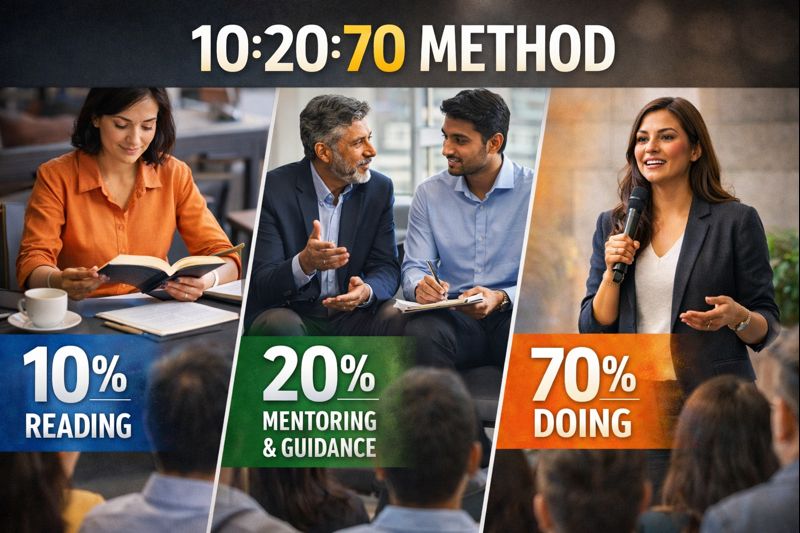
- 10:20:70 method: 10% reading, 20% guidance from mentors, and 70% doing. There is no substitute for doing, making errors, and learning. This is the easiest way to master any skill.

Step 3: Dedicate learning time every week
Create a habit by dedicating weekly time for learning. Keep a growth journal, set goals, measure progress, and reward yourself. Tell a couple of people what you are learning to build pressure on yourself.
The organisations that will win tomorrow are being built by people who are learning today. Growth is no longer about titles or tenure, it is about the audacity to create big impact and the courage to move from incremental to exponential.
Every skill you build compounds your impact as a leader. The future belongs to those who prepare for it. Start now, or regret it for life.


.jpg)

.jpg)
.jpg)


